Wolcottville's story doesn't begin with a grand vision or a gold strike. It begins the way most Indiana towns begin: with timber, water, and people stubborn enough to stay.
Before the Town: The Tamarack House (1832)
Years before George Wolcott ever set foot in LaGrange County, two French traders arrived. Sent from Fort Wayne by a trading company, they settled along the creek in 1832 and built a small cabin. Before long, they raised a double log structure made of tamarack poles. It became known simply as the Tamarack House.
A dam and sawmill followed. Then a small store. Then a gristmill. It wasn't much, but it was the first village in the area, a foothold in a landscape still thick with hardwood forest and swamp. The settlement was rough, temporary in the way frontier outposts often were. But one piece of it endured longer than anyone could have expected: a stone from that original gristmill still marks the southwest corner of Main and Race Streets today.
Walk past it and you're standing on the oldest known landmark in Wolcottville. Most people don't notice it. That's probably the most Wolcottville thing about it.
George Wolcott & the Mill (1837–1849)
George Wolcott was a Connecticut man who had lived in Ohio before heading west into Indiana. He arrived in 1837 with his wife Margaret, and together they built a log cabin along Little Elkhart Creek. The following year, Wolcott did the thing that would change the area permanently: he built a sawmill powered by the north branch of the Elkhart River.
In frontier Indiana, a sawmill wasn't just a business. It was the center of gravity. Every cabin, every barn, every fence post required cut lumber, and the nearest mill determined where people settled. Wolcott's mill drew laborers, farmers, and merchants. A community began to form around it, not by decree, but by the slow accumulation of people who needed boards and stayed for the neighbors.
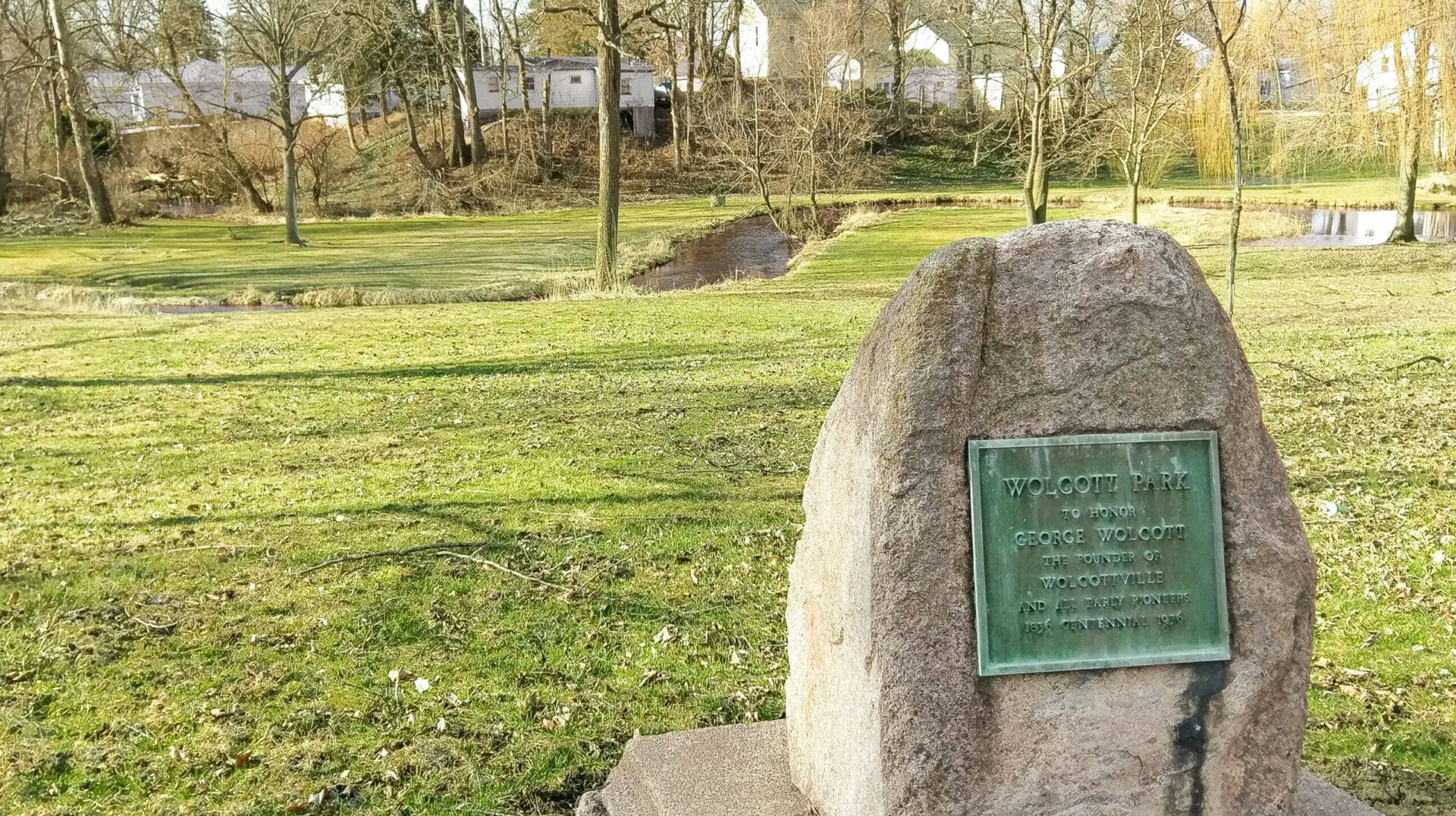
The commemorative stone marker at Wolcott Park, dedicated to George Wolcott and the early pioneers of Wolcottville. 1849 Centennial, 1949. Photo: Indiana Landmarks
Wolcott himself was no single-trade man. He expanded into grist milling, blacksmithing, merchandising, farming, and potash production, employing as many as 20 men at a time. He built over a dozen structures, founded the first store in the settlement, and even established a young ladies' seminary. When the growing village was officially platted in 1849, there was no question what it would be called. The place was George Wolcott's, and everyone knew it.
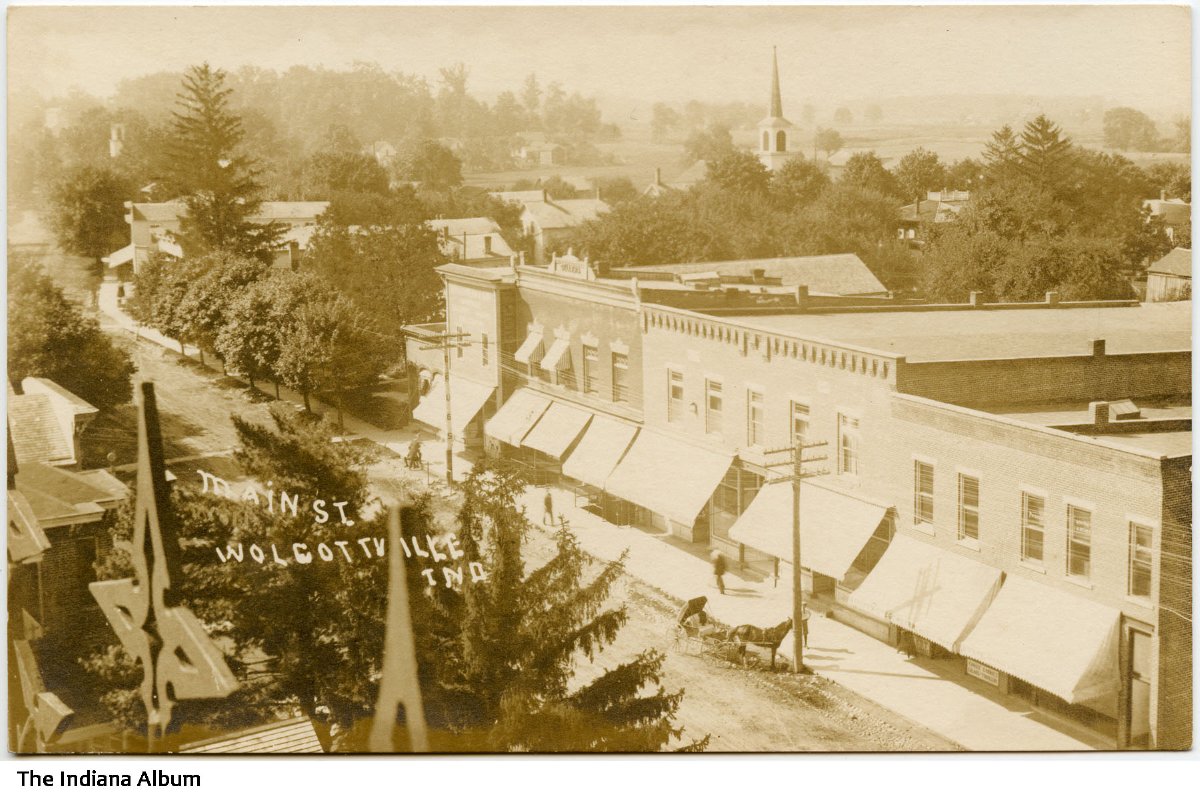
Bird's-eye view of Main Street businesses, Wolcottville, Indiana, circa 1910
The Wolcott House
Around 1838, George Wolcott built his family home along Little Elkhart Creek. It was an early Greek Revival structure, modest by the standards of eastern cities but ambitious for the Indiana frontier. For nearly 200 years, the house stood. For most of its life it passed between only two families, absorbing the quiet wear of generations without complaint.
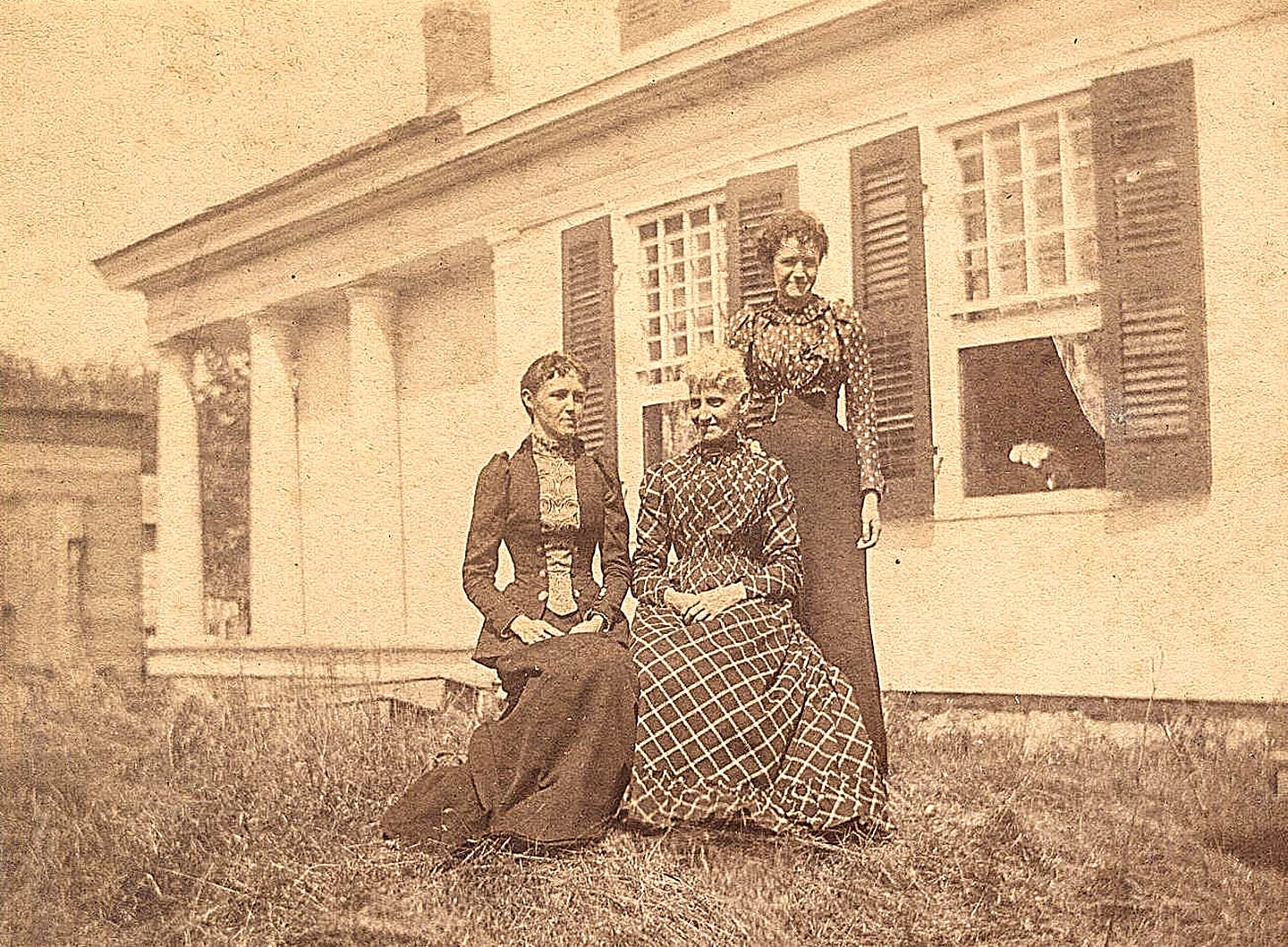
A circa 1900 photograph showing George Wolcott's daughter Abby (center) outside the Wolcott House. Abby lived in the home until her death in 1918, after which the house passed to a family she had taken in. The home was eventually donated to Indiana Landmarks. Photo: This Old House / Indiana Landmarks
By the early 2000s, the Wolcott House sat empty. The roof leaked. An addition had collapsed. The structure was deteriorating season by season, and most people in town figured it was a matter of time before someone tore it down. Another old building lost to neglect. It happens everywhere.
But a LaGrange County historian named Rex Fisher disagreed. Fisher knew what the house represented, not just architecturally, but as a direct physical link to the founding of the town. He pushed for preservation when preservation seemed like a lost cause. Through the efforts of Indiana Landmarks and the LaGrange County Community Foundation, the home was saved from foreclosure at the last possible moment.
The house was purchased and painstakingly restored by Drs. Daniel and Anna Kragt. The Kragts didn't stop at restoration. They relocated an 1760s Connecticut home, piece by piece, and added it to the property, connecting the Wolcott family's New England origins to its Indiana legacy in a way that George Wolcott himself might have appreciated.
The Wolcott House is now listed on the National Register of Historic Places, one of about a dozen structures in all of LaGrange County to earn that distinction. It stands on Wolcott Street, across from Wolcott Park, looking much as it did when the town was young.
For its first two decades, Wolcottville was a mill town, and a mill town only. Goods moved by wagon. News traveled slowly. The world beyond LaGrange County felt far away.
That changed in 1870 when the Grand Rapids and Indiana Railroad arrived. Suddenly, Wolcottville was connected. Lumber, grain, and manufactured goods could move through town and out to markets that had been unreachable before. The railroad didn't just carry freight. It carried ambition.
New businesses followed the tracks: a tannery, a rake factory, a foundry, a planing mill, a cooper shop, and a carriage factory. Wolcottville was making things, and shipping them. The Wabash Railroad arrived in 1893, adding east-west connectivity to a town that had previously only looked north and south. By 1900, the population had reached 659, the highest it had been, and the town felt like it was going somewhere.
Whether it got there is another question. But for a few decades at the turn of the century, Wolcottville hummed with the energy of a place that believed its best days were still ahead.
Wolcottville sits at the center of the Indian Lakes chain: Dallas, Witmer, Westler, Atwood, Messick, and Hackenburg. These are not resort lakes. There are no water parks, no boardwalks, no lake-themed gift shops. They are quiet bodies of water surrounded by trees and modest homes, the kind of lakes where you learn to fish before you learn to swim.
Generations of families from Fort Wayne, South Bend, and across Indiana have summered here. Small cottages appeared along the shorelines in the mid-20th century, some seasonal, some eventually winterized and made permanent. The lakes bring a seasonal swell to the community each year: boat trailers in driveways, extra cars at the bait shop, unfamiliar faces at the diner.
The relationship between year-round residents and lake families has shaped Wolcottville's character in ways that persist to this day. It's a town that knows how to welcome people in without losing itself in the process.
The railroads are gone. The factories are gone. The tannery, the rake factory, the carriage shop, all of it. But the town remains: about 1,000 people, one square mile, and the same stubborn sense of place it has always had.
The schools carry the mill's name. The gristmill stone still sits on the corner of Main and Race. The Wolcott House stands restored on Wolcott Street. And every summer, the lakes fill up again with families who have been coming here longer than they can remember.
Wolcottville doesn't have a brand or a five-year strategic plan. It has something harder to manufacture: continuity. The thread that runs from two French traders in 1832 to a man from Connecticut in 1837 to a historian who wouldn't let an old house die runs through this town still. It's not always visible. But it's there, in the names on the streets and the stone on the corner and the people who choose, year after year, to stay.
Notable People
Small towns don't usually make headlines, but every now and then, someone from a place like Wolcottville steps onto a bigger stage, and the town remembers.
Ken Kercheval
Actor
Born and raised in Wolcottville, Kercheval went on to play Cliff Barnes on the long-running TV drama Dallas, a role he held for more than a decade. He never forgot where he came from.
A Wolcottville native who rose to statewide prominence, Taylor served as Indiana's top legal officer at the turn of the century, proof that even a town of a few hundred could produce leaders.
George Wolcott's mill didn't just start a town, it named a school. Wolcott Mills Preschool, part of the Lakeland School Corporation, carries that name to this day. It's a small thing, maybe, but in a place like this, names matter. They're how a community remembers where it came from.
The local schools serving Wolcottville residents today are Wolcott Mills Preschool, Lakeland Primary School, Lakeland Intermediate School, and Lakeland Jr/Sr High School. Together they serve families across the surrounding countryside, the same land George Wolcott cleared timber from nearly two centuries ago.
For more Wolcottville and LaGrange County history, visit our sister publication at lagrangecountygazette.com.